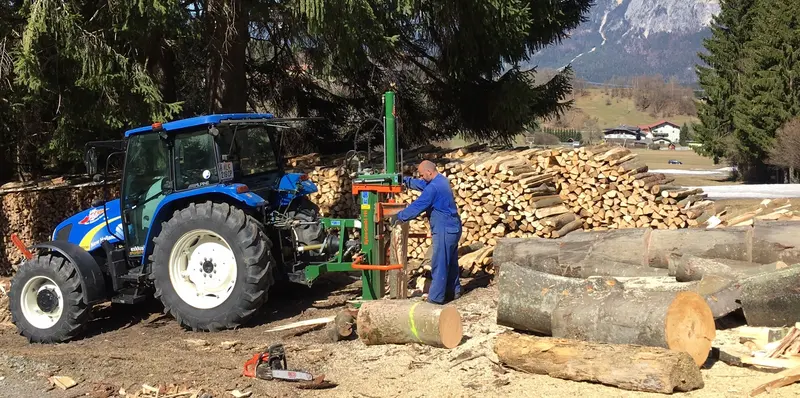
Many of the machines on this site come in more than one version. A cement mixer can be mains, petrol or battery; a log splitter can be electric or petrol; a pressure washer or a mitre saw can be corded or cordless. The motor matters less than you might think — what changes is where you can use the machine, what you have to store, and which safety rules you need to follow.
This article sets out the trade-offs in plain terms. For any one machine, the maker's figures and manual are what count.
Petrol: no socket, but fumes and fuel
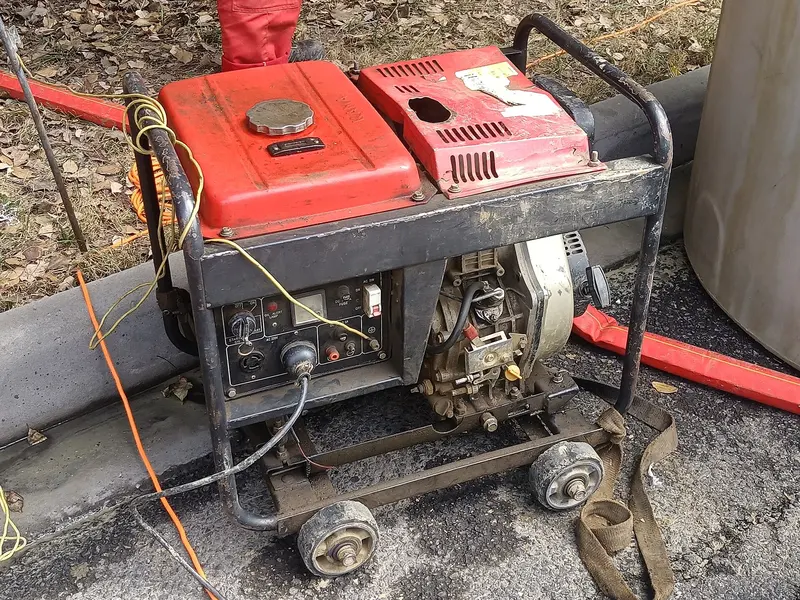
A petrol engine is the obvious choice when the job is a long way from a socket — a field, an allotment, a building plot with no supply yet — or when a machine needs more power than a household socket can give for long periods.
The price of that freedom is exhaust and fuel. Honda's safety advice for its engines is blunt: never run the machine in a confined or partly confined space, because the exhaust contains carbon monoxide, and keep a generator at least one metre from buildings and other equipment while it runs. Our guide to generators and carbon monoxide explains why "partly enclosed" includes a garage with the door open.
Petrol also has to be kept somewhere. HSE says you can store up to 30 litres at home without telling anyone, in suitable containers (up to 10 litres in a plastic one, 20 litres in a metal one), and never in your living space. See storing petrol at home for the details. Fuel goes stale too — more on that in our article on E10 petrol and small engines.
Engines need routine care that electric motors don't: oil, air filters, spark plugs and a proper shut-down routine before winter. The maker's manual sets the intervals.
Mains electric: steady power, a cable to manage
Mains machines are usually the simplest to own. There is no fuel to store and no battery to look after, and a mains motor will run for as long as the job needs, within its duty rating.
The cable is the thing to think about. HSE's advice for electrical equipment is to check the plug and cable before use, unplugged: no damage, no internal wires showing, no repairs with insulating tape. Extension leads need the same checks, and trailing cables should be placed so they aren't a trip hazard and are less likely to get damaged.
Outdoors, use a residual current device (RCD). HSE says an RCD rated at no more than 30 mA limits the energy in certain electric shocks and can save your life, and recommends one particularly in wet or damp places such as outdoors. Press its test button before use. A plug-in RCD only protects what is plugged into it — it does nothing for a machine plugged into a different socket.
An RCD is a back-up, not a licence to take risks. HSE points out it can't protect you from every kind of electric shock, so damaged cables still need replacing, not taping.
Some workshop machines — larger welders, for example — need a 16 A supply rather than an ordinary 13 A plug. That is in the maker's specification, and on our product pages under "Power".
Battery: quiet and tidy, with limits
Battery machines have improved a great deal. They start at the press of a button, produce no exhaust, and are usually quieter than an engine. Several makers now use one battery across a whole range, so a single pack might run a shredder, a mitre saw and a pressure washer.
The limits are running time and power. Check the maker's own figures for run time per charge and whether a battery and charger are included — many cordless machines are sold "bare" (tool only). On our product pages this shows in the key figures and the power line, for example "two 18 V batteries" or "sold separately".
Batteries also dislike extremes. Kärcher advises not leaving battery garden machines outside over winter, storing batteries at about 75 per cent charge and, where possible, between 10 and 20 °C. Follow the charger instructions in the manual, and use the maker's own charger.
Noise
If you have neighbours, noise may decide it for you. Outdoor machines such as lawnmowers, leaf blowers and generators must carry a label with their guaranteed sound power level, so you can compare models before you buy. Our article on noise and neighbours explains what the decibel figures mean, and why a few dB makes more difference than it looks.
Three examples from the site
Cement mixers are a good illustration — the same drum in mains, petrol and battery versions:
Cement mixers
Belle Minimix 150
- Key figures
- 130 l drum · 90 l mix · 24 rpm
- Power
- Petrol (Honda GX120 or Loncin) or electric (110 V / 230 V)
- Good for
- Small to medium building jobs; site and hire use
A heavier-duty tip-up mixer built for site and hire use, available with petrol or electric drive.
Details of Belle Minimix 150 Search Amazon for this — Belle Minimix 150 (opens Amazon.co.uk)
Cement mixers
Belle Minimix 130
- Key figures
- 130 l drum · 90 l mix · 26.5 rpm
- Power
- Mains electric (230 V), 0.45 kW
- Good for
- Concrete and mortar for smaller jobs
A light tip-up mixer that works on or off its stand, for concrete and mortar.
Details of Belle Minimix 130 Search Amazon for this — Belle Minimix 130 (opens Amazon.co.uk)
Cement mixers
Belle Minimix 150E+ Battery Cement Mixer
- Key figures
- 130 l drum · 90 l mix · about 20–30 mixes per charge
- Power
- Battery (82 V max / 72 V nominal), 1.5 kW
- Good for
- Mixing without a socket, fuel or exhaust fumes
A battery-powered version of the Minimix 150, so there are no engine emissions and no mains cable.
Details of Belle Minimix 150E+ Battery Cement Mixer Search Amazon for this — Belle Minimix 150E+ Battery Cement Mixer (opens Amazon.co.uk)
As an Amazon Associate we earn from qualifying purchases. Most Amazon links open a search on Amazon.co.uk, where you can see the current price, sellers and delivery. We don’t show prices, ratings or Amazon’s photos.
A quick way to decide
- No socket within reach, long or heavy jobs: petrol (outdoors only) or a large battery system.
- Near the house or in a workshop: mains, with an RCD outdoors and checked leads.
- Short jobs, close neighbours, little storage space: battery, if the maker's run time suits the job.
- Whatever you choose: read the manual before first use and wear the protection it tells you to.
You can browse every machine by type on the site: