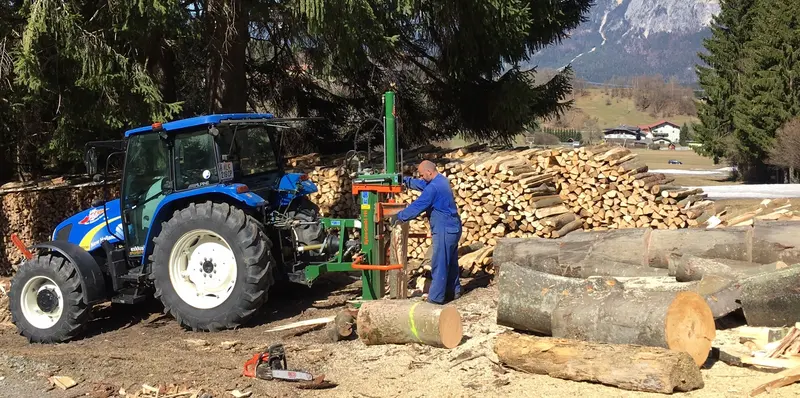
If you have a log burner, splitting your own firewood is satisfying work and a log splitter makes it far easier on the back. But a pile of freshly split logs isn't fuel yet. Wood that is burned wet makes more smoke, less heat and more tar in the chimney — which is why the rules on selling wood in England are built around one number: 20 per cent moisture.
The 20 per cent rule
Defra's Burn Better guidance says wet wood with a moisture content above 20 per cent produces lots of smoke, particles and tar deposits. Fine particles from stoves and open fires harm health, and the tar builds up in flues. Dry wood burns cleaner and gives more heat from the same log.
Ready to Burn: what it means when you buy
In England, wood sold in volumes of less than 2 cubic metres must be certified as Ready to Burn. GOV.UK says the certification confirms a moisture content of 20 per cent or less, and it covers bagged logs and small loose deliveries. Look for the Ready to Burn logo, supplier name and certificate number on the bag or next to the price.
Bigger loads — 2 cubic metres or more — don't need certifying, but the seller must give you a notice explaining how to dry, store and check the wood. That is a sign it may still need seasoning. Wales, Scotland and Northern Ireland have their own rules.
If you live in a smoke control area, GOV.UK notes that wood can only be burned in an exempt appliance there. Check your council's information before you light up.
Seasoning wood you split yourself
The government's customer notice is the simplest guide to drying your own wood:
- Dry it in a sunny, well-aired place for at least two years, keeping the rain off in winter.
- Stack it off the ground and leave the sides open to the wind. GOV.UK's advice to sellers is to store wood indoors, off the ground or under cover.
- Split it before you stack it, so it is ready to burn when it is dry — and so you can check it, as below.
- Use the oldest first so the pile keeps moving.
A purpose-made log store with a roof and slatted sides does all of this in a small space.
Checking it is dry
Signs that wood is ready, according to the customer notice, are radial cracks in the ends and bark that comes off easily. The best test is a moisture meter. Calibrate it first, then split a log and measure a freshly split surface — the outside of a log dries first and gives a misleadingly low reading. Burn it only once it reads 20 per cent or less.
A firewood moisture meter takes the guesswork out; follow its own instructions for calibrating it.
Using a log splitter safely
Before the drying comes the splitting, and a splitter's wedge and ram can do serious harm. Our guide to choosing a log splitter covers tonnage, log sizes and the controls and guards that keep hands away from the wedge. The points that come up again and again in the safety notes on our splitter pages:
- Only split logs within the size range the maker states — length and diameter.
- Use the controls exactly as designed; never wedge or tie a control down.
- Keep other people, children and pets well clear.
- Wear the protection the manual asks for — typically gloves, eye protection and safety boots.
- Petrol splitters only ever run outdoors, because of carbon monoxide.
Splitters on the site, with each maker's log sizes:
Log splitters
SIP 5 Ton Horizontal Electric Log Splitter (01976)
- Key figures
- 5 tonne · logs 50–250 mm diameter, 200–520 mm long
- Power
- Mains electric (230 V, 13 A), 2.2 kW
- Good for
- Home firewood in manageable lengths
A horizontal splitter inside a safety cage, with a wedge that returns on its own after each split. SIP says it suits softwoods and hardwoods for home use.
Details of SIP 5 Ton Horizontal Electric Log Splitter (01976) Search Amazon for this — SIP 5 Ton Horizontal Electric Log Splitter (01976) (opens Amazon.co.uk)
Log splitters
SIP 7 Ton Vertical Electric Log Splitter (01978)
- Key figures
- 7 tonne · logs 80–300 mm diameter, 100–550 mm long
- Power
- Mains electric (230 V, 13 A), 3 kW
- Good for
- Larger rounds where floor space is tight
A vertical splitter with a smaller footprint and more force than the 5 tonne model, for bigger rounds.
Details of SIP 7 Ton Vertical Electric Log Splitter (01978) Search Amazon for this — SIP 7 Ton Vertical Electric Log Splitter (01978) (opens Amazon.co.uk)
Log splitters
SIP 8 Ton Petrol Log Splitter (01987)
- Key figures
- 8 tonne · logs 70–300 mm diameter, 120–520 mm long
- Power
- Petrol (196 cc OHV, 6.5 hp)
- Good for
- Splitting in the field or woodland, away from mains
A petrol-engined horizontal splitter on rough-terrain wheels, so you can take it to the wood pile instead of the other way round.
Details of SIP 8 Ton Petrol Log Splitter (01987) Search Amazon for this — SIP 8 Ton Petrol Log Splitter (01987) (opens Amazon.co.uk)
As an Amazon Associate we earn from qualifying purchases. Most Amazon links open a search on Amazon.co.uk, where you can see the current price, sellers and delivery. We don’t show prices, ratings or Amazon’s photos.
Look after the stove too
Defra also recommends having your stove serviced once a year and the chimney swept at least once a year. Dry wood means less tar to sweep out — but it doesn't replace the sweep. And fit a carbon monoxide alarm in any room with a solid-fuel appliance; the NHS page on carbon monoxide poisoning lists the symptoms to know.