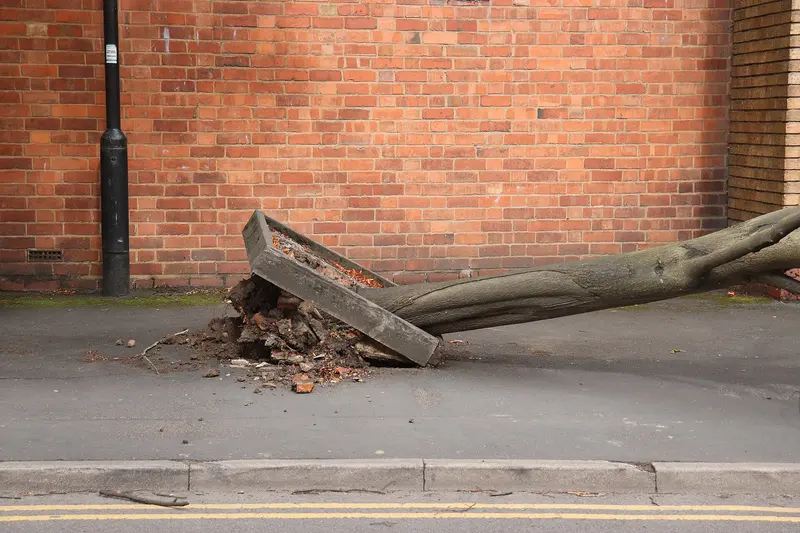
Winter storms bring trees and big branches down, and the first thought for many people is to get a chainsaw out. Cutting up a fallen or storm-damaged tree is skilled work, and for most householders the right answer is to call a professional. This article explains why, from HSE, Electrical Safety First, GOV.UK and the Arboricultural Association.
General safety information only. This site doesn't list chainsaws, and nothing here is training.
First: stay back
GOV.UK's Be Ready advice for after a storm is to be careful not to touch any electrical or telephone cables that have been blown down or are still hanging, and not to walk too close to walls, buildings and trees, as they could have been weakened. If a tree has brought down a cable or is leaning on one, keep everyone well away and report it to your electricity network operator — the Met Office notes that 105 is the free number that puts you through to your local network operator — or call 999 if someone is in immediate danger.
Power lines
HSE's guidance for tree work near overhead power lines says work within 10 metres of a line needs specialist advice from the line's owner, usually the network operator, before it starts — and that work further away still needs checking, because falling trees, timber and debris can breach the safe distance. It also warns that the danger isn't only contact: electricity can flash over to a person or object that is close enough.
Chainsaws: training first
HSE says anyone using a chainsaw at work must have received adequate training and be competent for the type of work they do. Electrical Safety First, writing for home users, says it is essential that anyone who uses a chainsaw should get adequate training to be competent in using it.
Electrical Safety First describes kickback — a sudden upward and backward throw of the saw towards the user — as the most common cause of serious accidents. A chain brake helps, but experienced users still get kickback, which is why the protective kit matters.
The protective kit HSE lists
HSE's chainsaw PPE page lists, with the standards each should meet:
- a safety helmet
- hearing protection
- a mesh visor or safety glasses/goggles for eye protection
- gloves (to BS EN 381-7 where chainsaw protection is needed)
- leg and groin protection (BS EN 381-5)
- chainsaw boots (BS EN ISO 17249) — gaiters are for occasional users on even ground, worn with steel-toe-capped boots
- non-snag outer clothing
Electrical Safety First's minimum for home users is specialist approved chainsaw PPE, a helmet, ear defenders, gloves and goggles, with chainsaw trousers and safety boots recommended. For electric saws it adds: use an RCD-protected socket, keep the cable behind you and away from the blade, use outdoor-rated extension leads and unwind cable reels fully. It also advises against buying a second-hand chainsaw.
Our guides cover hearing protection and eye and face protection.
Safety kit (PPE)
JSP Sonis Ear Defenders
- Key figures
- SNR 27–37 dB across the range · EN 352-1 / EN 352-3
- Power
- Passive (no batteries)
- Good for
- Picking the right level of protection for each machine
A colour-coded range of ear defenders, from green Sonis 1 for lower noise to red Sonis 3 for very loud work.
Details of JSP Sonis Ear Defenders Search Amazon for this — JSP Sonis Ear Defenders (opens Amazon.co.uk)
Safety kit (PPE)
uvex aXess one Active Bluetooth Earmuffs
- Key figures
- 31 dB noise reduction · EN 352-1
- Power
- Rechargeable (USB-C)
- Good for
- Long noisy sessions where you still need to hear warnings
Active earmuffs that let ambient sound and warning signals through at safe levels, with Bluetooth for calls and audio.
Details of uvex aXess one Active Bluetooth Earmuffs Search Amazon for this — uvex aXess one Active Bluetooth Earmuffs (opens Amazon.co.uk)
Safety kit (PPE)
uvex com4-fit Disposable Earplugs
- Key figures
- SNR 33 dB · EN 352-2
- Power
- Disposable foam
- Good for
- Under a welding helmet or with other kit; narrow ear canals
Small pre-shaped foam earplugs for people who find standard earplugs too big.
Details of uvex com4-fit Disposable Earplugs Search Amazon for this — uvex com4-fit Disposable Earplugs (opens Amazon.co.uk)
As an Amazon Associate we earn from qualifying purchases. Most Amazon links open a search on Amazon.co.uk, where you can see the current price, sellers and delivery. We don’t show prices, ratings or Amazon’s photos.
Protected trees
Before any work on a tree — even a damaged one — check whether it's protected. GOV.UK's guidance says a Tree Preservation Order stops anyone cutting down, topping, lopping, uprooting or wilfully damaging the tree without the council's written consent. There are exceptions:
- for a dead tree, 5 working days' prior written notice must be given to the council before felling or other work
- where a tree is an immediate risk of serious harm, urgent work can be done, but you must give written notice as soon as practicable, and only do what's needed to remove the risk
- trees in a conservation area without a TPO need 6 weeks' notice before certain work
Your council can tell you whether a tree is protected.
Finding a tree surgeon
The Arboricultural Association runs an ARB Approved Contractor directory of tree surgeons who have passed its assessment, which covers areas including customer care, insurance and the standard of finished work. It also has a directory of registered consultants if you need advice rather than work.
Smaller jobs you can do
Twigs and small branches on the lawn can usually be cleared by hand, cut with loppers or a pruning saw, and shredded — see shredding the Christmas tree for shredder safety, and splitting and drying firewood if the wood is going on the stove. If the power is off, see using a generator safely in a power cut.